At the 33rd Annual Session of the OSCE Parliamentary Assembly, held in The Hague from July 4 to 8, 2026, the Assembly adopted a resolution (“supplementary item”) I submitted, entitled “Keeping Youth at the Centre: Strengthening Democracy, Security and Human Capital in the OSCE Region amid Demographic Change.” The resolution has been incorporated into The Hague Declaration. (Fotos and a short report about the Session you can find here)
It recognizes demographic change as a major long-term trend shaping the OSCE region and calls for demographic considerations to be mainstreamed across institutions and policy areas. Among other priorities, it addresses support for families, meaningful opportunities for young people, intergenerational fairness, sustainable pension, healthcare, and social systems, active aging, brain circulation, skilled migration, and greater youth participation in democratic processes.
The full text is available here on pages 57–59: https://www.oscepa.org/en/documents/annual-sessions/2026-the-hague/declaration-32/5581-the-hague-declaration-eng/file
The Hague Declaration also includes further provisions addressing the effects of aging societies on democratic representation and public spending priorities, as well as the need to strengthen the meaningful participation of young people and ensure intergenerational balance in policymaking. These provisions can be found in paragraphs 173 and 203 on pages 27 and 32. I tabled these texts in my capacity as Special Representative of the OSCE PA for Demographic Change and Security. A report of my activities you can find here.)
For your convenience, please find the passages also here below. We would be delighted if you can use, quote, and disseminate them:
The Hague Declaration
CHAPTER III DEMOCRACY, HUMAN RIGHTS AND HUMANITARIAN QUESTIONS
173. Recognizing that ageing societies across the OSCE region may increasingly reshape democratic representation, political incentives and public spending priorities, particularly as older voters account for a growing share of the electorate, and further recognizing that, unless accompanied by meaningful youth participation and intergenerational balance in policymaking, these developments risk disadvantaging future generations in political decision making,
(Page 27)
203. Calls on OSCE participating States to strengthen the meaningful participation of young people in democratic life by ensuring intergenerational balance in policymaking and investing in policies that also benefit younger and future generations, and secure long-term societal resilience in response to ageing societies;
(Page 32)
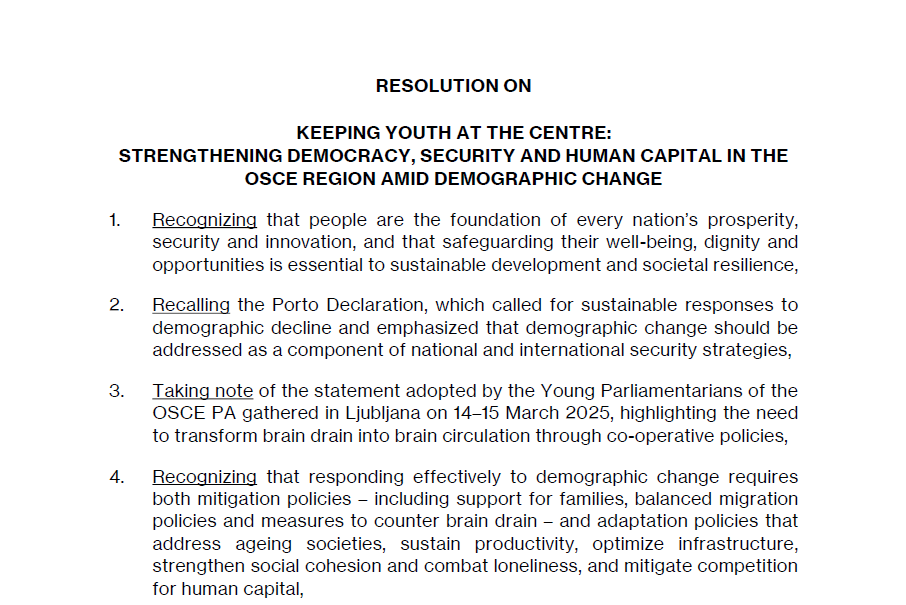
RESOLUTION ON KEEPING YOUTH AT THE CENTRE: STRENGTHENING DEMOCRACY, SECURITY AND HUMAN CAPITAL IN THE OSCE REGION AMID DEMOGRAPHIC CHANGE
- Recognizing that people are the foundation of every nation’s prosperity, security and innovation, and that safeguarding their well-being, dignity and opportunities is essential to sustainable development and societal resilience,
- Recalling the Porto Declaration, which called for sustainable responses to demographic decline and emphasized that demographic change should be addressed as a component of national and international security strategies,
- Taking note of the statement adopted by the Young Parliamentarians of the OSCE PA gathered in Ljubljana on 14–15 March 2025, highlighting the need to transform brain drain into brain circulation through co-operative policies,
- Recognizing that responding effectively to demographic change requires both mitigation policies – including support for families, balanced migration policies and measures to counter brain drain – and adaptation policies that address ageing societies, sustain productivity, optimize infrastructure, strengthen social cohesion and combat loneliness, and mitigate competition for human capital,
- Aware that labour migration contributes significantly to economic growth, innovation and intercultural understanding across the OSCE region, while also posing challenges, sometimes called brain drain or muscle drain, uneven distribution of education, financial burdens of professional training, and intergenerational tension, as well as demographic competition – competition for people and talent, and competing interests regarding the retention and return of skilled migrants,
- Recognizing that the brain drain seen in the OSCE region in different forms and degrees of intensity weakens labour markets, accelerates demographic decline and widens regional disparities,
- Concerned that declining birth rates and youth emigration have significant implications for democratic resilience, social cohesion, economic sustainability and the long-term resilience of societies in the OSCE region,
- Recognizing that ageing electorates may create political incentives that do not sufficiently reflect the interests of younger generations, and that safeguarding democratic resilience requires ensuring that democratic institutions remain inclusive, representative and responsive to citizens of all ages,
- Concerned that the under-representation of young people in political processes, party structures and elected institutions may create a structural intergenerational democratic deficit whereby younger cohorts, despite having the longest temporal stake in political outcomes, hold comparatively limited electoral weight and may be insufficiently reflected in policymaking, thereby affecting the legitimacy, intergenerational fairness and long-term resilience of democratic systems,
The OSCE Parliamentary Assembly:
- Calls on the OSCE, and in particular the Office for Democratic Institutions and Human Rights (ODIHR), to examine the nexus between demographic change, security, democracy and youth participation, including its implications for political participation, representation, intergenerational fairness and inclusion, encourages ODIHR, within its mandate and upon request, to provide research, legislative and technical assistance to OSCE participating States, including through efforts to quantify and qualify intergenerational democratic deficits and to support youth participation at national, regional and local levels, and further calls on the Office of the Co-ordinator of OSCE Economic and Environmental Activities to analyse the economic and labour market implications of demographic developments, including population ageing, migration, productivity and regional disparities, and to report on policy options to strengthen resilience and sustainable development across the OSCE region;
- Calls on OSCE participating States to recognize demographic change as a major long-term trend shaping the OSCE region and to mainstream demographic considerations across institutions and policy fields, adopting a long-term perspective beyond electoral cycles;
- Calls on OSCE participating States to promote an intergenerationally balanced social and political environment in which parenthood is socially recognized and family life is supported, citizens are enabled to realize their desired number of children, and young people are offered meaningful prospects through local job creation, entrepreneurship, innovation and opportunities for home ownership, and to boost productivity and economic competitiveness, also by the inclusion of artificial intelligence where appropriate;
- Calls on OSCE participating States to undertake sustainable reforms of pension, healthcare and social systems and to support older people through active ageing policies, quality of life measures and efforts to reduce loneliness and social isolation, thereby strengthening social connectedness, democratic inclusion and solidarity between generations;
- Urges OSCE participating States to strengthen bilateral and multilateral skills mobility partnerships and brain circulation frameworks, including structured exchange programmes, mobility partnerships and the systematic development of diaspora networks, such as the “Migration for Development” programmes of the International Organization for Migration, in order to enable skilled migrants to contribute to both host and origin countries through knowledge transfer, co-education, remote collaboration, investment and sustained professional engagement, and encourages the creation of opportunities and incentives for such engagement;
- Urges OSCE participating States to address the structural drivers of emigration and social frustration by strengthening accountability, combating corruption and promoting good governance, the rule of law, fair remuneration, contract certainty, effective labour-law remedies and attractive career prospects, recognizing these as essential pillars of sustainable demographic and migration policy and as decisive factors in retaining skilled professionals;
- Encourages the establishment of “dual intent” vocational and academic programmes that equip participants for employment opportunities both locally and abroad, fostering sustainable human capital development;
- Encourages OSCE participating States to pursue transparent and efficient recognition of qualifications, accessible language training and mentoring programmes, to enable migrants to contribute fully to host societies;
- Condemns all forms of oppression and exploitation of migrant workers, including human rights violations reportedly occurring in certain regions, such as the treatment of Central Asian migrants in the Russian Federation, and urges OSCE participating States to ensure the full protection of migrant workers’ rights and access to justice;
- Supports the exchange of best practices among OSCE participating States, academia, the private sector and international organizations to promote brain circulation, namely circular migration models that prevent one-sided depletion of human resources, such as the Internationale Fachkräfteinitiative of the Austrian Economic Chamber;
- Recommends that OSCE participating States strengthen the democratic participation and representation of young people by reducing legal, administrative and financial barriers to voter registration, candidacy and electoral participation, including through simplified and digital voter registration, accessible voting arrangements for citizens in rural, remote and depopulating areas, and, where appropriate and compatible with national constitutional frameworks, electronic voting, and further encourages parliaments and public institutions to consider mechanisms such as youth caucuses, youth councils, advisory bodies and structured consultations with youth representatives;
- Encourages OSCE participating States to ensure intergenerational fairness in policymaking, including through intergenerational impact assessments and balanced investment in the next generation, such as for education, housing, family support and opportunities for younger generations.
(Page 57 – 59)